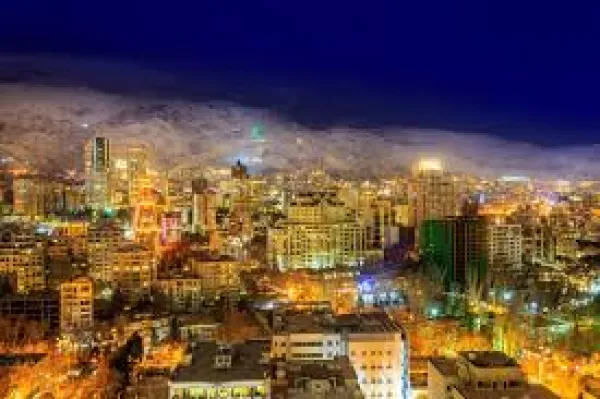
Tehran, at night: # IranOpenAlbum (Danielle Harte for Bourse & Bazaar), CC BY 2.0 <https://creativecommons.org/licenses/by/2.0>, via Wikimedia Commons
Last night, the United States and Israel launched what can only be described as an unprovoked and illegal attack on Iran. The strikes reportedly targeted several Iranian cities, including the residences of the Supreme Leader and the President, along with other state officials and military and security sites.
Yet beyond the declared military objectives lies a harsher reality: non-military areas were hit, homes were reduced to rubble, and civilians paid the price. In Minab, a girls’ elementary school was struck, leaving dozens of children dead or wounded under what were cynically framed as “liberating bombs.” In Kermanshah, the residential neighborhood of Pardis was also attacked. Whatever the stated aims, the human toll is undeniable.
There are also reports that the Islamic Republic has launched dozens of missiles toward Israel, as well as toward Bahrain, Qatar, and Iraq—where U.S. military installations are located—raising the specter of a wider regional war. This escalation unfolds against the backdrop of years of conflict and devastation across Palestine, Lebanon, Syria, and beyond.
In an address to the American public, Donald Trump characterized the attack as a “preemptive” strike undertaken to defend the “security” of the American people from what he called the “evil” government of the Islamic Republic. In a separate message directed at Iranians, he warned that “outside is very dangerous” and that “bombs will fall everywhere,” urging them to “take control of your government” once the bombing ends and promising that a “moment of freedom” may be near.
Such rhetoric, cloaked in the language of liberation, serves a different function: it attempts to recast war as benevolence and devastation as opportunity. It also seeks to channel popular anger in ways that ultimately preserve geopolitical interests rather than empower genuine democratic transformation.
This joint war—waged in the name of security—has instead deepened insecurity across the region. It has fueled inflation, driven up prices, destroyed homes, and shattered lives. It has destabilized entire societies while narrowing political space, as states invoke war to suppress dissent and silence opposition. The burdens fall not on those who order the strikes, but on ordinary people whose livelihoods and futures hang in the balance.
Whether the current regime survives, fragments, or is replaced by elements within its own ranks—or by pro-American or pro-Israeli opposition forces—the risk remains that Iranians will continue to endure authoritarian rule in new forms. Prolonged war could further fracture the country, intensifying internal divisions and plunging the region into deeper instability.
Americans, too, must ask hard questions. To what extent is U.S. policy toward Iran guided by independent strategic calculation, and to what extent does it align with the security priorities and political influence of the Israeli government? Are Americans prepared for the costs—financial, moral, and strategic—of another prolonged Middle Eastern conflict?
At a time when major educational, research, health, and social welfare programs in the United States face deep cuts, one question becomes unavoidable: who will pay for this war? And what domestic sacrifices will be demanded in its name?
The 2003 invasion of Iraq was widely seen as having been shaped, in part, by intense lobbying and a climate of fear-driven rhetoric. Today’s escalating language calls to confrontation echo that earlier moment with unsettling familiarity. Before history repeats itself, the public deserves clarity about whose interests are truly being served—and at whose expense.
Contact information
Nader Rahimi
Email:nrahimi@bu.edu